AI-Assisted Development: ODS Spark Replatform with Agents
AI-Assisted Development: ODS Spark Replatform with Agents
Replatforming BT Panorama's Spark applications from legacy DSE Spark 2.4 to Databricks Cloud Runtime was a massive undertaking: 377 source files, thousands of test cases, and tight coupling to outdated dependencies. Here's how we used AI agents to dramatically accelerate the effort.
Project Overview
The migration was driven by DSE 6.9.0 approaching end-of-life, with the codebase tightly coupled to unsupported dependencies and outdated APIs. Our modernization targets:
- Databricks Cloud Runtime 17.3 LTS
- Spark 3.5.2 (up from 2.4)
- Scala 2.12.17
- Replace legacy DSE drivers with cloud-native alternatives
- Rebuild test infrastructure on local Cassandra with dual cluster connectivity
Benefits
Evergreen platform, scaling flexibility, AI-ready data pipelines, and significant TCO reduction.
Codebase Statistics
| Type | Count |
|---|---|
| Batch Jobs | 37 |
| Delta Jobs | 79 |
| Migration Jobs | 7 |
| Schedule Jobs | 24 |
| Test Cases | 2,982 |
| Entity/Case Classes | 273 |
The AI Agent Framework
Rather than using a single generalist AI, we built a multi-agent system with specialized roles coordinated by a master orchestrator:
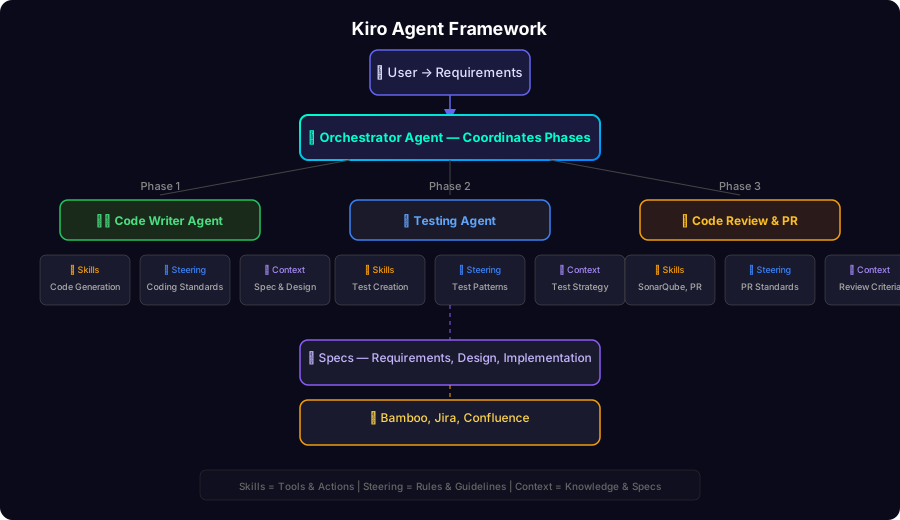
Orchestrator Agent - Coordinates phases and tracks state across the pipeline
Phase 1: Code Writer Agent
- Analyzes existing job patterns
- Generates migrated code following coding standards
- Uses spec & design docs as context
Phase 2: Testing Agent
- Creates comprehensive test suites
- Runs tests against local Cassandra
- Validates dual-write phases (local → dual → cloud-only)
Phase 3: Code Review & PR Agent
- Reviews code quality and compatibility
- Checks for deprecated APIs and JDK 17 compliance
- Commits to feature branch and creates PR on Bitbucket
Each agent is equipped with:
- Skills - Tools & actions (code generation, test runner, SonarQube, Artifactory, Bamboo)
- Steering - Rules & guidelines (coding standards, test patterns, PR standards)
- Context - Knowledge & specs (design docs, implementation plans, review criteria)
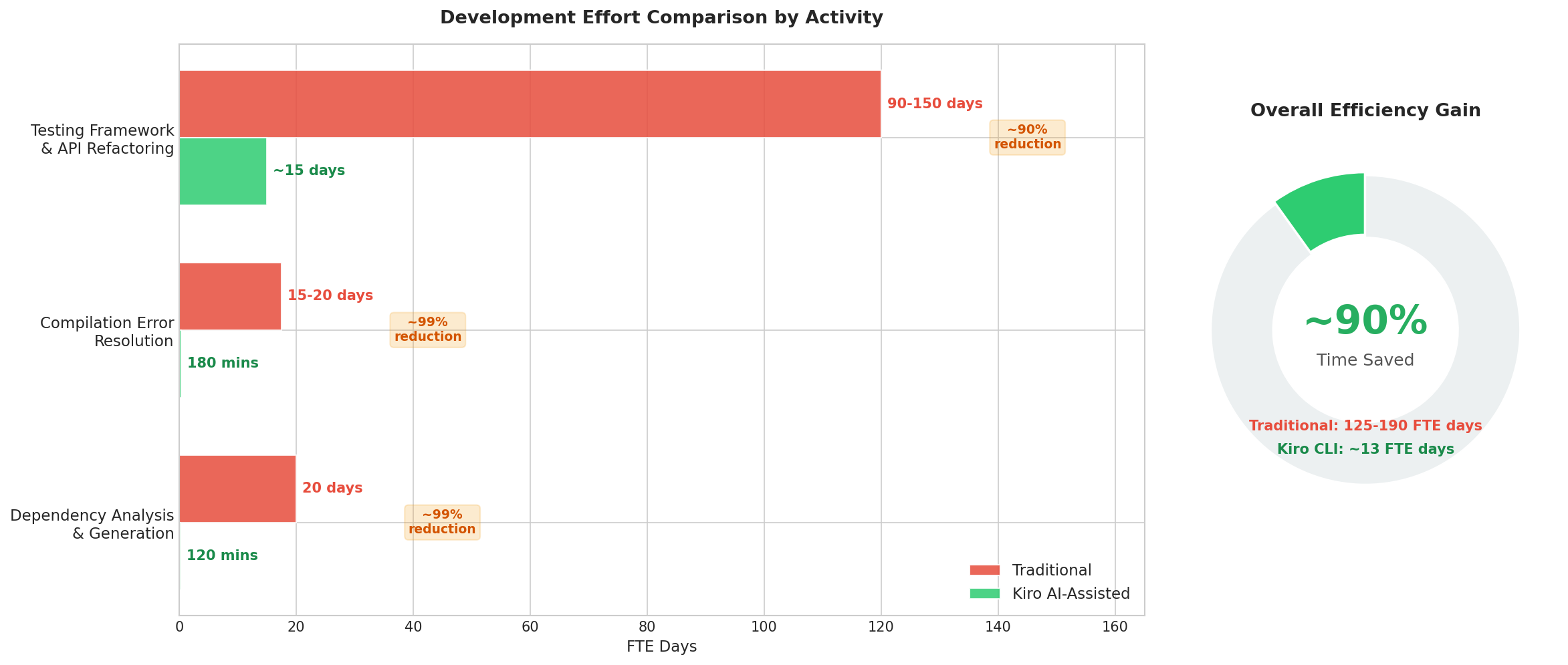
Development Efficiency
Demo: Full Dev Cycle in 20 Minutes
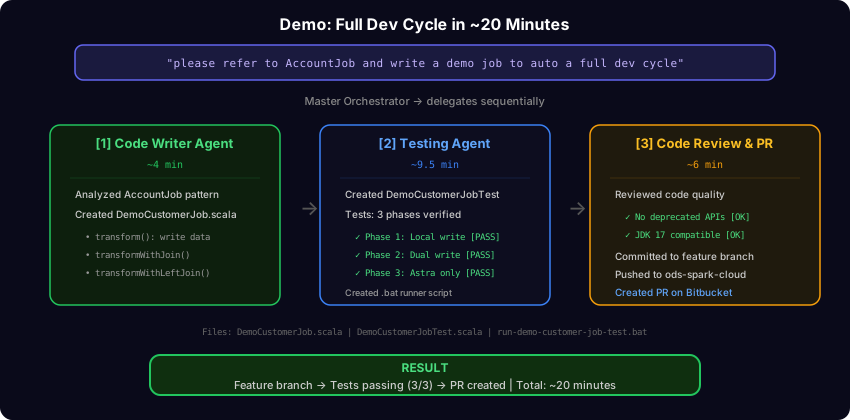
A single prompt - "please refer to AccountJob and write a demo job to auto a full dev cycle" - triggered the entire pipeline:
- Code Writer Agent (~4 min) - Analyzed AccountJob pattern, created
DemoCustomerJob.scalawithtransform(),transformWithJoin(), andtransformWithLeftJoin()methods
- Testing Agent (~9.5 min) - Created
DemoCustomerJobTest.scalawith 3 phases verified:
- Code Review & PR Agent (~6 min) - Reviewed code quality, confirmed no deprecated APIs, verified JDK 17 compatibility, committed to feature branch, pushed, and created PR on Bitbucket
Result: Feature branch → Tests passing (3/3) → PR created | Total: ~20 minutes
Lessons Learned
- Spec-driven beats vibe coding - Requirements.md + design.md produces more consistent, reproducible results than ad-hoc prompting
- Specialized agents outperform generalists - Dedicated code-writer, testing, and code-review agents each excel at their domain
- Steering docs are critical - Code guidelines, test patterns, and context docs reduce hallucination and keep output on-track
- Context window management matters - Large codebases (377 files) require filtered compilation and targeted context injection
Conclusion
AI-assisted development isn't about replacing engineers - it's about amplifying them. By combining specialized agents with well-defined specs and steering documents, we turned a multi-quarter migration into a streamlined, repeatable process where a full development cycle takes minutes instead of hours.